Business
EPFO Rules 2026: 5 Major PF Updates Employees Should Know, From Auto-Transfer to UPI Withdrawals
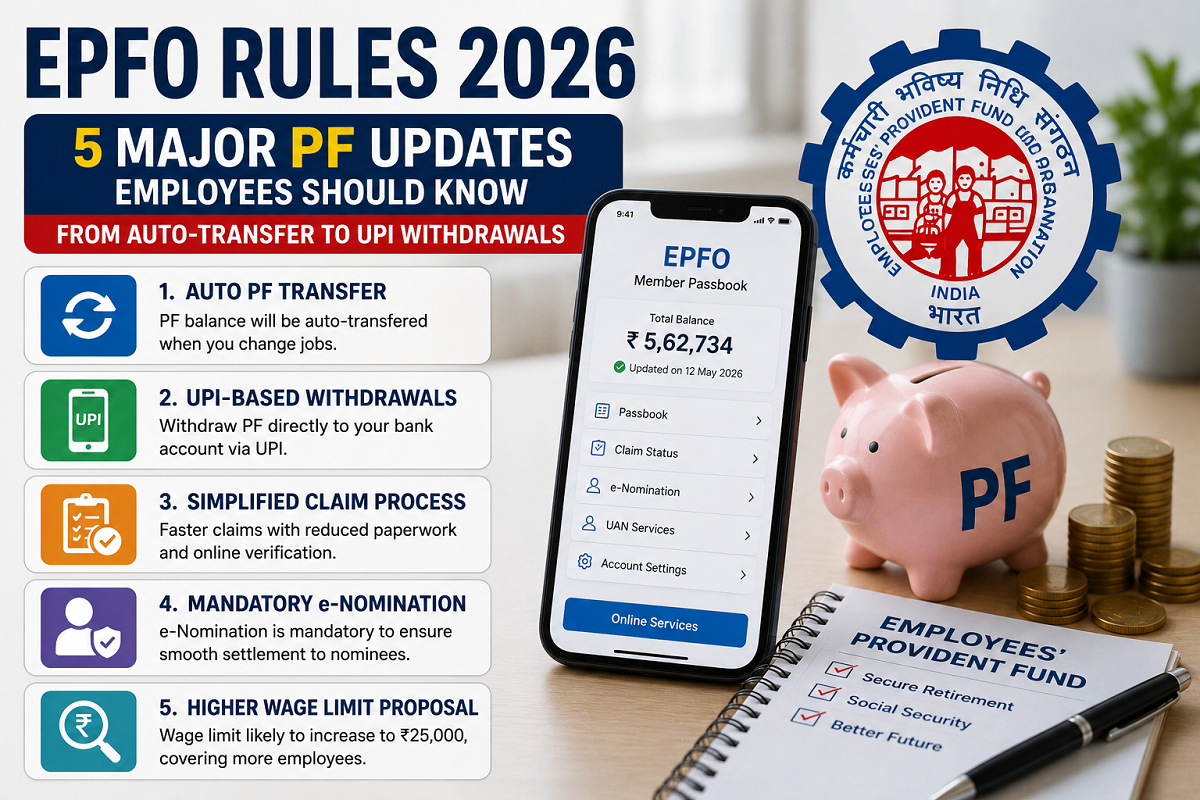
EPFO Major Changes in 2026: The Employees’ Provident Fund Organisation (EPFO) is introducing several changes aimed at making provident fund services faster, simpler and more digital. From easier PF transfers after switching jobs to plans for UPI-based withdrawals, these developments could affect millions of salaried employees across India.
For EPF members, understanding which facilities are already available and which are still being rolled out is important. Here are five major EPFO-related updates to watch in 2026.
1. PF Transfer After Changing Jobs Gets Easier
Changing jobs has traditionally meant ensuring that the provident fund balance linked to the previous employer is transferred correctly to the new employment record.
EPFO has been simplifying this process to reduce the need for employees to submit separate transfer requests in eligible cases.
Where a member’s UAN is properly linked with Aadhaar and the required KYC details are updated, PF transfer can be processed with substantially less intervention.
The objective is to create greater continuity under a single UAN when an employee moves from one EPF-covered organisation to another.
Why This Matters
Employees previously had to keep track of their old and new PF accounts and, in many cases, initiate transfer requests. Greater automation can reduce paperwork, processing delays and the risk of leaving old PF balances unmerged.
Members should still ensure that their Aadhaar, UAN, bank account and KYC information are correct and updated.
2. EPFO Expands Automated Claim Settlement
Automation is becoming an increasingly important part of EPFO's claim-processing system.
Eligible PF advance claims can already be processed through automated systems, reducing the need for manual verification in qualifying cases.
The next major area of focus is making other categories of PF settlements faster and more automated, including final settlement claims where applicable.
If successfully implemented at scale, automation could significantly reduce the time between submitting an eligible claim and receiving the money in the registered bank account.
However, claim approval will continue to depend on eligibility, verified member details and the applicable EPFO withdrawal rules.
3. UAN Activation Through UMANG Gets Greater Focus
Another significant digital change relates to Universal Account Number (UAN) activation and generation.
EPFO has been pushing Aadhaar-based digital verification through the UMANG app, including facial authentication for applicable UAN-related services.
The system uses Aadhaar-linked identity verification to establish that the person activating or generating the UAN is the genuine member.
This approach is intended to strengthen identity verification, improve the quality of member records and reduce the possibility of fraudulent UAN-related transactions.
What Employees Should Keep Ready
Members using Aadhaar-based UAN services should ensure that their Aadhaar information and mobile-linked authentication requirements are in order.
They should also use only official EPFO, UMANG and government-authorised platforms instead of clicking on UAN or PF-related links received through unknown messages.
4. Faster PF and Pension Claim Processing
Reducing claim-processing time remains another important area of EPFO's digital transformation.
Automation can allow eligible claims with correctly verified information to be settled much faster than claims requiring manual scrutiny.
The article also highlights stricter timelines relating to eligible pension claims, including a 20-day processing benchmark in applicable cases.
It further refers to provisions concerning interest in cases where pension claims are delayed without a valid reason. Members should note that the applicability of any interest or compensation depends on the relevant EPFO/EPS rules and circumstances of the individual claim.
Therefore, a member should not assume that every delayed PF or pension claim will automatically attract a 12% interest payment.
5. UPI-Based PF Withdrawal Facility in the Pipeline
One of the most closely watched developments is a proposed system designed to make access to eligible PF withdrawals more convenient through India's digital-payment infrastructure.
Under the proposed framework, members could eventually be able to initiate eligible PF-related transactions through a UPI-linked system, with the approved amount reaching the linked bank account.
Once funds are credited to the bank account, they can naturally be accessed through the bank's normal payment and withdrawal channels, including ATMs where available.
Importantly, members should distinguish between withdrawing PF directly from an ATM and receiving an approved PF claim in a bank account that can subsequently be accessed through an ATM.
Until the new facility is officially made available to all members, employees should rely on existing authorised EPFO claim channels.
EPFO Changes in 2026: Quick Overview
| EPFO Update | What It Means for Members |
|---|---|
| Easier PF transfer | Less manual work when changing jobs in eligible cases |
| Automated settlements | Faster processing of qualifying PF claims |
| UAN through UMANG | Greater use of Aadhaar-based facial authentication |
| Faster claims | Automation aimed at reducing settlement time |
| UPI-linked withdrawal system | Proposed easier access to approved PF withdrawals |
What EPF Members Should Do Now
Employees can prepare for the expanding digital services by ensuring that their UAN is active, Aadhaar is correctly linked, bank details are verified, mobile number is updated and KYC information is complete.
Incorrect Aadhaar information, mismatched names, outdated bank details or incomplete KYC can still result in claim or transfer delays even when the underlying process is automated.
Don't Confuse Proposed Features With Existing Rules
Some EPFO reforms are already operational, while others—including broader UPI-based access to PF money—may be under development or phased implementation.
Members should therefore verify the latest status through official EPFO or government channels before submitting claims or making financial decisions.
Bottom Line
EPFO's direction in 2026 is clearly towards automation, faster settlements and reduced paperwork. Easier transfers can help employees changing jobs, while automated claims can shorten processing times. Aadhaar-based authentication is strengthening digital verification, and proposed UPI-linked services could make access to eligible PF withdrawals more convenient.
For employees, the most important step is simple: keep the UAN, Aadhaar, bank account and KYC details accurate and updated so that new digital EPFO services can work without unnecessary delays.