Business
8th Pay Commission: Pensioners Seek ₹45,000 Minimum Pension, Quarterly DR Revision and 3.83 Fitment Factor
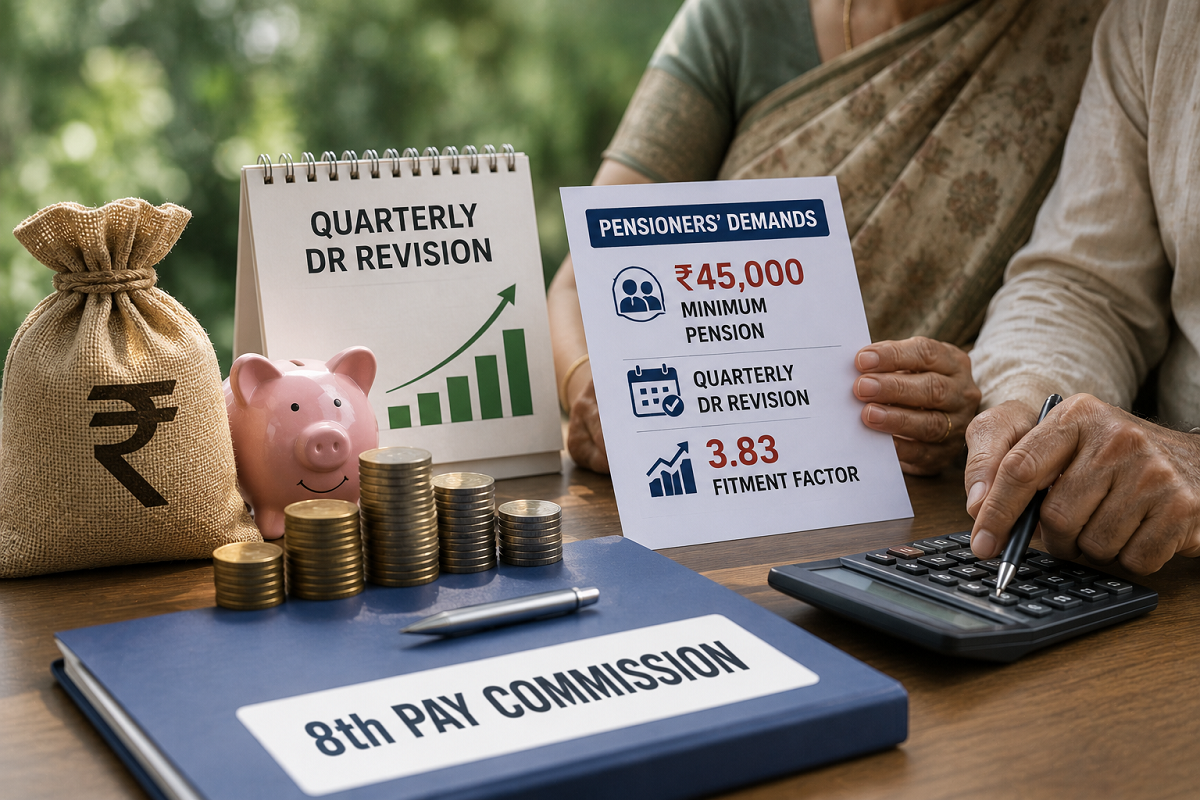
8th Pay Commission Pensioners Demands: Central government pensioners have placed a series of major proposals before the 8th Central Pay Commission, including a sharp increase in minimum pension, more frequent Dearness Relief (DR) revisions and parity between existing and future retirees.
Bharat Pensioners Samaj (BPS), which represents around 10 lakh pensioners, reportedly met officials of the 8th Pay Commission on August 7, 2026. The organisation submitted proposals covering minimum pension, fitment factor, family pension, inflation protection and periodic pension reviews.
Importantly, these figures are demands submitted by the pensioners' organisation and not approved pension rates. The final decision will depend on the recommendations of the 8th Pay Commission and subsequent approval by the central government.
Minimum Pension of ₹45,000 Proposed
One of the biggest demands raised by BPS is to increase the minimum basic pension to ₹45,000 per month.
Under the 7th Pay Commission framework, the minimum basic pension is currently ₹9,000 per month. If the proposal is accepted in its present form, the minimum pension would rise five-fold.
The organisation has also reportedly sought:
| Proposal | Demand |
|---|---|
| Minimum Basic Pension | ₹45,000 per month |
| Minimum Basic Pay | ₹69,000 per month |
| Fitment Factor | 3.83 |
| Pension at Retirement | Up to 67% of last pay |
| Family Pension | Up to 50% of last pay |
| DR Revision | Every 3 months |
| Pay and Pension Review | Every 5 years |
These are proposals presented before the Commission and should not be treated as confirmed benefits.
Pensioners Demand DR Revision Every Three Months
At present, Dearness Allowance (DA) for serving central government employees and Dearness Relief (DR) for pensioners are generally revised twice a year, with revisions linked to January and July cycles.
BPS has proposed that DR for pensioners should instead be reviewed every three months.
The argument is that quarterly revisions could help pensioners receive faster protection against rising living costs rather than waiting six months for an adjustment.
Proposal to Merge DR With Basic Pension at 25%
Another significant demand concerns the merger of Dearness Relief with basic pension.
According to the proposal, once DR crosses 25%, it should be merged with the basic pension. The pensioners' body believes such a mechanism could provide better long-term protection against inflation.
However, no such rule has yet been approved under the 8th Pay Commission.
Pension Up to 67% of Last Salary
BPS has also proposed a change in the way retirement pension is determined.
The organisation wants pension at retirement to be fixed at up to 67% of the employee's last salary.
For family pension, it has proposed a level of up to 50% of the last salary.
If considered by the Commission, these proposals could substantially affect retirement benefits. However, the eventual formula may differ depending on the Commission's recommendations and the government's decision.
Pay and Pension Review Every Five Years
Instead of waiting for long intervals between successive Pay Commissions, pensioners have proposed a five-year review cycle for salaries and pensions.
The idea is to ensure that compensation and retirement benefits remain more closely aligned with inflation, living costs and changing economic conditions.
This proposal, too, remains under consideration rather than being an announced policy.
Demand for Parity Between Old and New Pensioners
BPS has also raised the issue of pension parity.
The organisation wants employees retiring before and after January 1, 2026 to receive comparable financial treatment when they retire from equivalent posts.
In other words, pensioners argue that two employees retiring from the same or equivalent position should not face a major difference in pension merely because their retirement dates fall on opposite sides of a cut-off date.
The demand broadly focuses on the principle of comparable pension benefits for similarly placed retirees.
What Would a 3.83 Fitment Factor Mean?
The pensioners' organisation has demanded a 3.83 fitment factor for the 8th Pay Commission.
A simple multiplication of the existing minimum basic pension of ₹9,000 by 3.83 gives:
₹9,000 × 3.83 = ₹34,470
This is considerably below BPS's separate demand for a ₹45,000 minimum pension. Therefore, the ₹45,000 proposal should not be interpreted as the automatic outcome of applying a 3.83 fitment factor to the existing ₹9,000 pension.
Similarly, the proposed ₹69,000 minimum basic salary is a separate demand and not necessarily the mathematical outcome of the fitment factor alone.
When Could the 8th Pay Commission Report Arrive?
The central government constituted the 8th Central Pay Commission on November 3, 2025, under the chairmanship of former Supreme Court judge Justice Ranjana Prakash Desai.
The Commission has been given 18 months to submit its recommendations. Based on this timeline, its final report could be submitted around May 2027, though the actual schedule will depend on the Commission's work and consultation process.
Following its Delhi consultations, the Commission is expected to hold further discussions with employee and pensioner organisations in cities including Jaipur, Chennai, Puducherry and Chandigarh.
Will Pensioners Definitely Get ₹45,000?
No. The ₹45,000 minimum pension, 3.83 fitment factor, quarterly DR revision, 67% pension formula and other figures discussed above are demands made by a pensioners' organisation.
The 8th Pay Commission will examine representations from different stakeholders before making its recommendations. The central government will then decide which recommendations to accept, modify or reject.
Therefore, central government pensioners should wait for the Commission's official recommendations and subsequent government notification before calculating their revised pension on the basis of these proposals.