
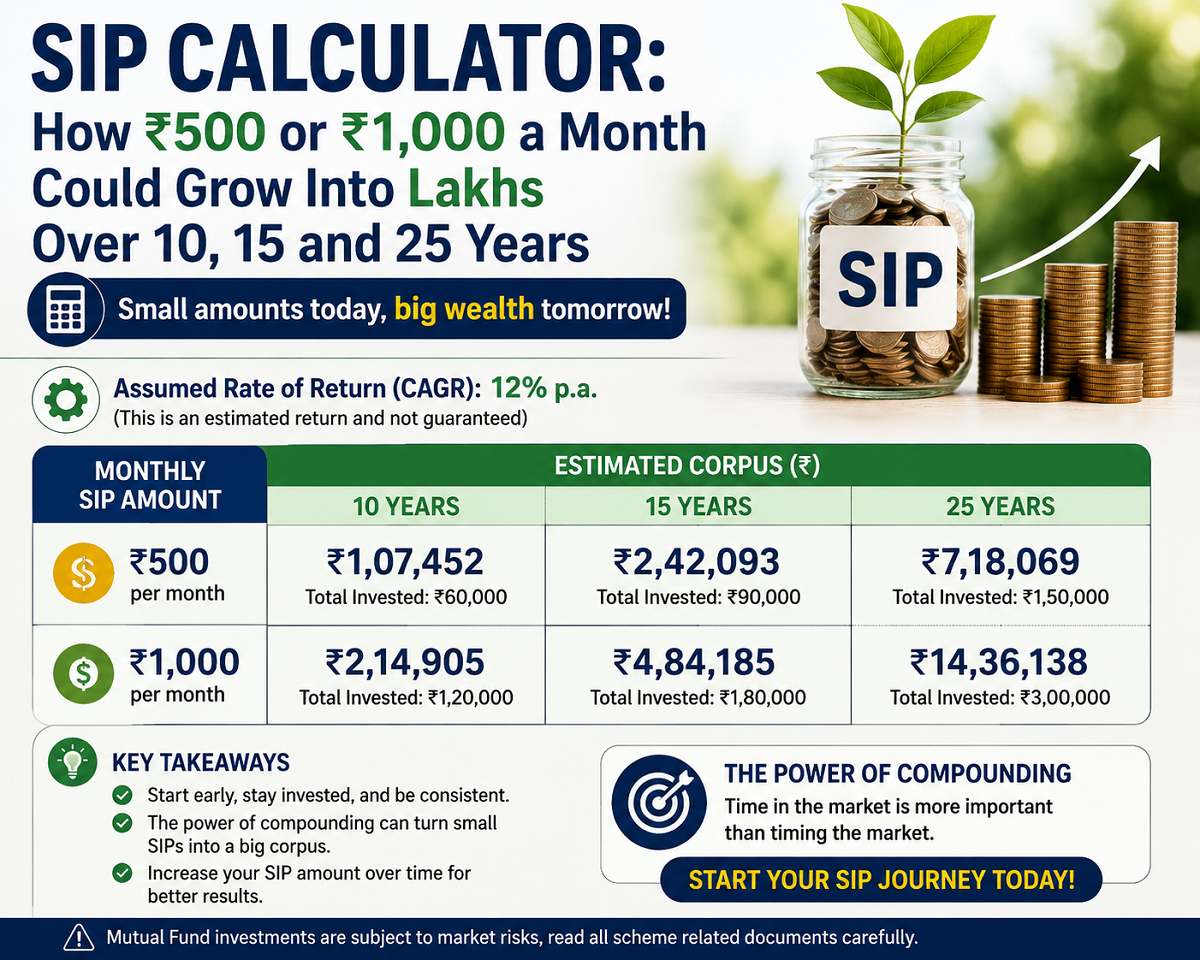
SIP Return Calculation: Building a meaningful investment corpus does not always require a large monthly contribution. Even relatively small amounts such as ₹500 or ₹1,000 invested regularly through a Systematic Investment Plan (SIP) can potentially grow into several lakhs over a long period.
The key factors are consistency, time and the return generated by the underlying mutual fund.
For illustration, if an investor earns an average annualised return of 12%, a ₹500 monthly SIP could grow to nearly ₹9.49 lakh over 25 years. A ₹1,000 monthly investment under the same assumptions could build a corpus of roughly ₹18.98 lakh.
However, these figures are projections rather than promises. Mutual fund returns are market-linked and can be higher or lower than the assumed 12%.
What Is a SIP?
A Systematic Investment Plan is a method of investing a fixed amount in a mutual fund at regular intervals, such as every month.
Instead of investing a large lump sum at once, an investor can contribute smaller amounts periodically.
For example, someone choosing a ₹1,000 monthly SIP would invest ₹12,000 over one year.
A SIP itself is not a separate investment product. The returns depend on the mutual fund scheme in which the SIP money is invested.
Mutual fund investments are exposed to market risks, so returns are not fixed or guaranteed.
₹500 Monthly SIP: How Much Could It Become?
A contribution of ₹500 per month works out to approximately ₹16-17 per day when averaged across a month.
Although the amount may appear small, investing it consistently over a long period can create a much larger corpus.
Assuming an average annual return of 12%, here is the illustrative calculation:
| Investment Period | Total Amount Invested | Estimated Gains | Estimated Corpus |
|---|---|---|---|
| 10 years | ₹60,000 | ₹56,170 | ₹1,16,170 |
| 15 years | ₹90,000 | ₹1,62,288 | ₹2,52,288 |
| 25 years | ₹1,50,000 | ₹7,98,818 | ₹9,48,818 |
The most noticeable difference appears over the longest period.
In 25 years, the investor contributes only ₹1.50 lakh from their own pocket, but the assumed investment growth adds nearly ₹7.99 lakh.
The final projected corpus therefore reaches approximately ₹9.49 lakh.
₹1,000 Monthly SIP: Full Calculation
Doubling the monthly contribution to ₹1,000 naturally produces a significantly larger projected corpus.
At the same hypothetical 12% annualised return:
| Investment Period | Total Amount Invested | Estimated Gains | Estimated Corpus |
|---|---|---|---|
| 10 years | ₹1,20,000 | ₹1,12,339 | ₹2,32,339 |
| 15 years | ₹1,80,000 | ₹3,24,576 | ₹5,04,576 |
| 25 years | ₹3,00,000 | ₹15,97,635 | ₹18,97,635 |
After 25 years, the investor would have contributed ₹3 lakh.
Under the assumed return, the investment gains would be around ₹15.98 lakh, taking the projected corpus close to ₹19 lakh.
This demonstrates why investment duration can have such a strong influence on long-term outcomes.
Why Does the Corpus Grow Faster in Later Years?
The answer lies in compounding.
Investment returns can themselves remain invested and potentially generate additional returns in subsequent years.
During the early years, the corpus is relatively small, so the amount generated through compounding is limited.
As the investment base grows, however, the same percentage return applies to a larger amount.
This is why the difference between a 15-year and 25-year investment can appear disproportionately large even though the monthly SIP amount remains unchanged.
Time Can Matter More Than Starting With a Big Amount
Consider the ₹1,000 example.
Over 10 years, the projected corpus is about ₹2.32 lakh.
Extending the same SIP to 15 years takes it to approximately ₹5.05 lakh.
Continuing for 25 years raises the projection to almost ₹19 lakh.
The investor has not changed the monthly amount in this example. The major difference is simply the additional time available for contributions and compounding.
This is one reason starting early can be valuable for long-term financial goals.
What Is Rupee Cost Averaging?
SIPs are also associated with a concept called rupee cost averaging.
Mutual fund units are purchased at the prevailing Net Asset Value, or NAV, on the relevant investment date.
When market prices are lower, the same SIP contribution generally purchases more units.
When markets are higher, the contribution purchases fewer units.
Over time, regular investment can therefore reduce the need to repeatedly decide when to enter the market.
AMFI notes that SIPs encourage disciplined investing and can help investors deal with market timing and volatility through regular purchases.
Does Rupee Cost Averaging Guarantee a Profit?
No.
Rupee cost averaging does not guarantee positive returns or eliminate investment risk.
If the mutual fund performs poorly, an investor can still earn a low return or suffer losses, particularly over shorter periods.
Its main advantage is behavioural: investors continue investing systematically instead of trying to predict every market high and low.
What If Returns Are Lower Than 12%?
The assumed return makes a substantial difference to the final corpus.
A 12% annual return should therefore be viewed only as an example for understanding how SIP calculations work.
Actual mutual fund returns can vary widely depending on the category of fund, asset allocation, market conditions, fees and investment period.
Equity-oriented funds can also experience sharp fluctuations from year to year.
Investors should not choose a mutual fund simply because an online calculator shows an attractive future value at 12%.
Increasing the SIP Can Accelerate Corpus Growth
Investors whose income rises over time may consider gradually increasing their SIP contribution.
For example, someone who begins with ₹1,000 a month could raise it periodically as their salary increases.
A step-up strategy can potentially create a larger long-term corpus than keeping the monthly contribution unchanged.
However, the amount should remain affordable so that the SIP can be sustained even during periods of higher expenses or market volatility.
Don't Stop a SIP Only Because Markets Fall
Market corrections can make new investors nervous.
However, automatically stopping a long-term SIP solely because the market declines may defeat the purpose of regular investing.
During lower market levels, the same amount can purchase more mutual fund units.
That said, investors should review the underlying scheme if its fundamentals, investment strategy, risk profile or suitability have changed.
Continuing blindly in an unsuitable fund is different from remaining disciplined during normal market volatility.
Match the Mutual Fund With Your Goal
Not every mutual fund is appropriate for every investor.
An investor saving for a goal 20 years away may be able to tolerate more short-term volatility than someone who needs the money in two years.
Before starting a SIP, investors should consider their goal, investment horizon, risk tolerance and emergency-fund position.
SEBI's investor guidance notes that mutual fund schemes have different objectives and investors should choose schemes that align with their own needs.
Small SIPs Can Be a Useful Starting Point
A ₹500 or ₹1,000 monthly SIP may not create a huge corpus overnight, but it can help establish a disciplined investing habit.
Under an assumed 12% annual return, ₹500 per month could potentially reach around ₹9.49 lakh in 25 years, while ₹1,000 could grow to approximately ₹18.98 lakh.
The more important lesson is not that 12% will definitely be earned. It is that regular investing over long periods can allow even modest contributions to benefit from compounding.
Investors should therefore treat SIP calculators as planning tools rather than return guarantees and select mutual funds only after considering their objectives and risk profile.
Disclaimer: Mutual fund investments are subject to market risks. The calculations above assume a constant 12% annual return for illustration only. Actual returns can be higher or lower, and no future corpus is guaranteed. Investors should read scheme-related documents carefully and seek professional financial advice where appropriate.