Business
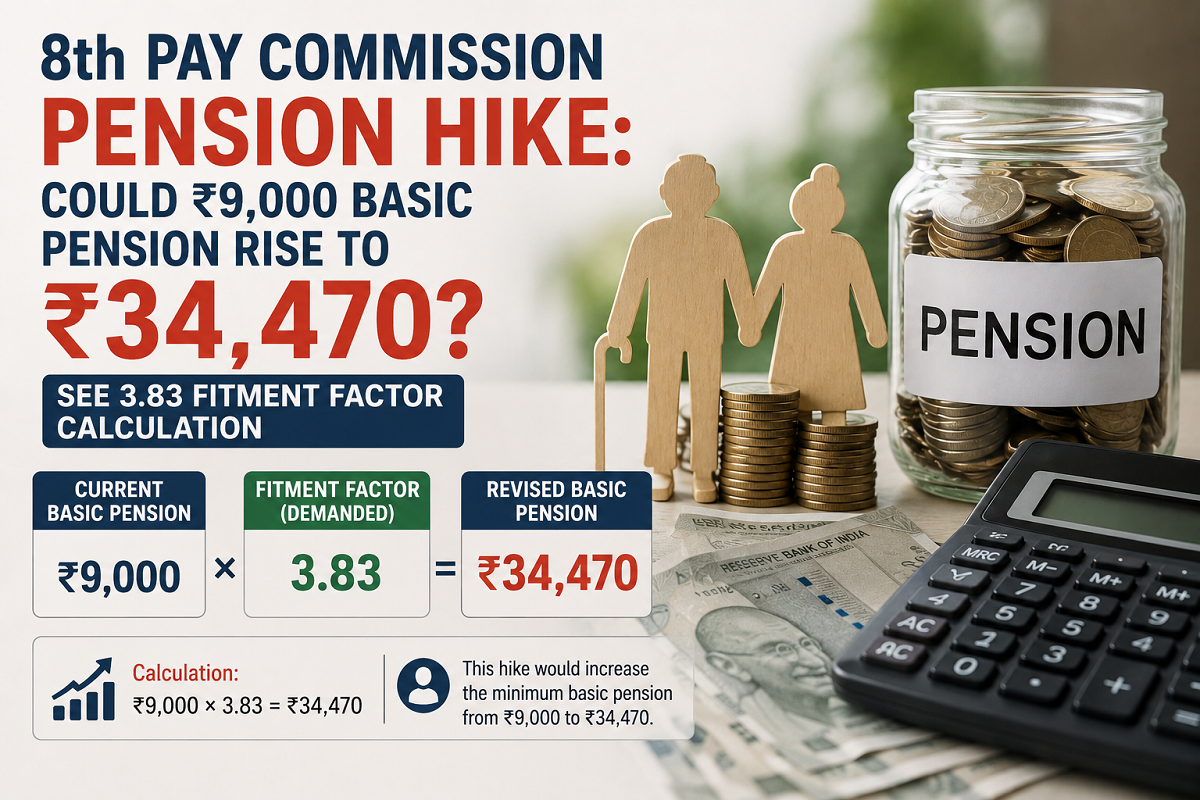
8th Pay Commission Pension Hike: Could ₹9,000 Basic Pension Rise to ₹34,470? See 3.83 Fitment Factor Calculation
8th Pay Commission Pension Calculation 2026: Central government pensioners are closely watching developments around the 8th Central Pay Commission, with one question dominating discussions: how much could monthly pension increase after the next revision?
The 8th Pay Commission was officially constituted on November 3, 2025, and has been given 18 months to submit its recommendations. Until the Commission completes its review and the government accepts the final recommendations, there is no confirmed fitment factor or revised pension amount.
However, employee representatives have proposed a fitment factor of 3.83. If such a multiplier were eventually accepted and applied directly to existing basic pension, it could result in a substantial revision.
Here is how the numbers would look under that purely illustrative scenario.
What Is the Current Minimum Basic Pension?
Under the existing 7th Central Pay Commission framework, the minimum basic pension is ₹9,000 per month.
When the 7th Pay Commission was implemented, a fitment factor of 2.57 was adopted for revising pay. The minimum basic pay for central government employees consequently moved from ₹7,000 under the earlier structure to ₹18,000.
The minimum pension under the 7th CPC framework was fixed at ₹9,000.
With the 8th Pay Commission process underway, pensioners are now waiting to see how the next revision will be structured.
NC-JCM Side Has Sought a 3.83 Fitment Factor
The Staff Side of the National Council-Joint Consultative Machinery (NC-JCM) has reportedly placed a demand for a 3.83 fitment factor.
It is important to distinguish a demand from a government decision. A 3.83 multiplier has not yet been officially approved as the 8th Pay Commission fitment factor.
If, purely for calculation purposes, the 3.83 multiplier were applied directly to existing basic pension, the formula would be:
Illustrative revised basic pension = Existing basic pension × 3.83
Using that formula, a person currently receiving a basic pension of ₹9,000 would arrive at:
₹9,000 × 3.83 = ₹34,470
Therefore, under this hypothetical calculation, the minimum basic pension could move from ₹9,000 to ₹34,470 per month.
3.83 Fitment Factor: Pension Calculation Table
Here is what different basic pension levels would look like if multiplied by 3.83:
| Current Basic Pension | Calculation | Illustrative Revised Basic Pension |
|---|---|---|
| ₹9,000 | ₹9,000 × 3.83 | ₹34,470 |
| ₹10,000 | ₹10,000 × 3.83 | ₹38,300 |
| ₹15,000 | ₹15,000 × 3.83 | ₹57,450 |
| ₹20,000 | ₹20,000 × 3.83 | ₹76,600 |
| ₹25,000 | ₹25,000 × 3.83 | ₹95,750 |
| ₹30,000 | ₹30,000 × 3.83 | ₹1,14,900 |
| ₹40,000 | ₹40,000 × 3.83 | ₹1,53,200 |
| ₹50,000 | ₹50,000 × 3.83 | ₹1,91,500 |
These figures are mathematical illustrations only. They should not be interpreted as officially announced pension amounts.
The final calculation methodology could differ depending on the recommendations made by the 8th Pay Commission and the decisions subsequently taken by the central government.
Pensioners' Groups Seek ₹45,000 Minimum Pension
Apart from the discussion around the fitment factor, pensioners' organisations have also raised separate demands regarding minimum pension and Dearness Relief.
Among the demands attributed to organisations such as Bharat Pensioners Samaj (BPS) is an increase in minimum basic pension from the existing ₹9,000 to ₹45,000 per month.
Other demands reportedly include changes in the way Dearness Relief is handled, including proposals for its periodic merger with basic pension after reaching a specified level and more frequent revision.
These remain demands from representative bodies and should not be confused with final recommendations of the Pay Commission or approved government policy.
What Happened Under the 7th Pay Commission?
The previous Pay Commission provides useful context, although the 8th CPC does not necessarily have to follow the same methodology.
Under the 7th Central Pay Commission, a 2.57 fitment factor was adopted for revising pay.
The minimum basic pay consequently increased from ₹7,000 to ₹18,000, while the minimum pension under the new structure was fixed at ₹9,000.
This precedent is one reason the fitment factor has become one of the most closely watched numbers in discussions surrounding the 8th Pay Commission.
However, simply assuming that the 8th CPC will follow exactly the same approach could be misleading.
Has the Government Approved a 3.83 Fitment Factor?
No.
As of now, there is no final government announcement confirming that 3.83 will be the fitment factor under the 8th Pay Commission.
The figure represents a demand/proposal associated with employee representatives.
The Pay Commission must examine a wide range of factors before making its recommendations. These may include existing pay and pension structures, inflation, government finances, allowances, service conditions and broader economic considerations.
The Union government will then examine the recommendations before deciding which proposals should be accepted, modified or rejected.
What Could Happen to Dearness Relief After Pension Revision?
Dearness Relief (DR) is another important issue for pensioners.
Pensioners should not simply add the prevailing DR percentage on top of a hypothetical revised pension calculation to estimate their future monthly payment.
When a new Pay Commission's recommendations are implemented, the pension structure and the treatment of accumulated inflation compensation are reset according to the government's approved methodology.
A fresh DR cycle then generally begins on the revised basic pension according to the applicable rules.
Therefore, calculations such as current basic pension × 3.83 + existing DR may significantly overstate the likely pension and should not be treated as an official projection.
How Much Is the Increase From ₹9,000 to ₹34,470?
If the 3.83 multiplier were applied directly, the mathematical increase would be:
Existing basic pension: ₹9,000
Illustrative revised basic pension: ₹34,470
Increase: ₹25,470 per month
In percentage terms:
₹25,470 ÷ ₹9,000 × 100 = 283% increase
However, the revised amount is 3.83 times the existing pension, or 383% of the old basic pension. This distinction is important: a 3.83 multiplier does not mean a 383% increase; it represents a 283% increase over the original amount.
What If Minimum Pension Is Fixed at ₹45,000?
The demand for a ₹45,000 minimum pension is separate from the 3.83 fitment-factor calculation.
For comparison:
₹45,000 ÷ ₹9,000 = 5
That means raising the minimum basic pension directly from ₹9,000 to ₹45,000 would make it five times the current amount, representing a 400% increase over the existing minimum.
This is substantially higher than the ₹34,470 figure generated by simply applying a 3.83 multiplier.
Whether either approach finds a place in the Commission's final recommendations remains uncertain.
When Could the 8th Pay Commission Report Arrive?
The Commission was constituted on November 3, 2025 and has been provided an 18-month period to complete its work.
That puts the expected report timeline around early May 2027, subject to the official process and any subsequent developments.
Submission of the report, however, will not automatically mean that revised pensions will immediately begin.
The central government will first need to study the recommendations and decide which proposals to accept. Implementation details—including the effective date, revised pension formula, fitment methodology, allowances and treatment of arrears—would become clear only after government approval.
What Should Pensioners Watch Next?
For pensioners, three developments will be particularly important: the fitment or pension-revision formula recommended by the Commission, the minimum pension proposed in its final report, and the effective date eventually approved by the government.
Until those details are officially announced, figures such as 3.83 fitment factor, ₹34,470 minimum pension or ₹45,000 minimum pension should be treated as scenarios or demands—not confirmed benefits.
The final pension increase could be higher or lower depending on the recommendations of the 8th Central Pay Commission and the Union government's eventual decision.
Disclaimer: The pension calculations above are illustrative and based on a hypothetical 3.83 multiplier. The government has not confirmed 3.83 as the final 8th Pay Commission fitment factor or ₹34,470/₹45,000 as the revised minimum pension. Pensioners should rely on official government notifications for final figures.