Business
RBI Gives Fresh Update on ₹10 and ₹20 Polymer Notes; Paper Currency Will Continue Alongside New Trial Notes
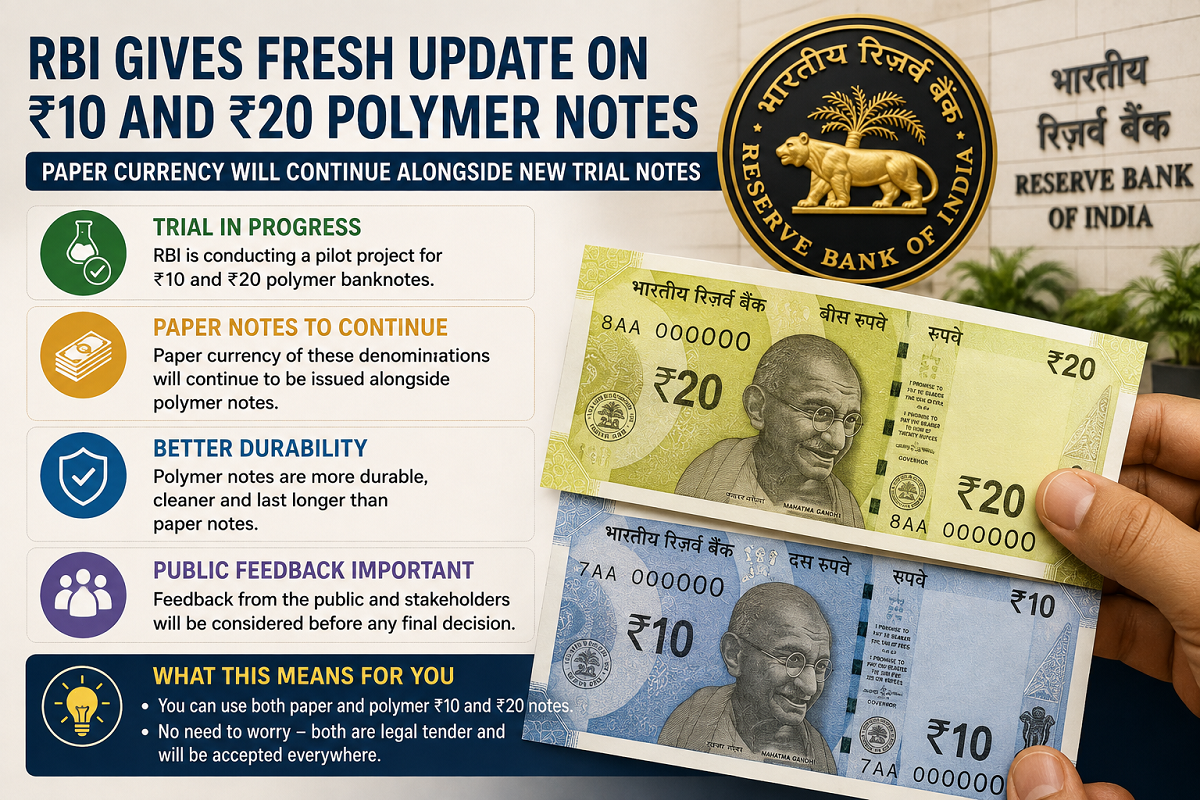
RBI Polymer Notes Update: The Reserve Bank of India has shared a fresh update on its proposal to introduce polymer-based ₹10 and ₹20 banknotes. Following the Central Government's approval for field trials, RBI Governor Sanjay Malhotra confirmed that the project is moving ahead in phases. However, existing paper currency will continue to remain legal tender, and there are no plans to withdraw the current ₹10 and ₹20 notes.
RBI Moves Ahead With Polymer Currency Trial
India could soon witness the introduction of polymer banknotes in the ₹10 and ₹20 denominations as the Reserve Bank of India prepares for the next stage of its currency modernization initiative.
The Central Government has already approved the RBI's proposal to conduct field trials of polymer notes. The pilot project aims to evaluate how the new banknotes perform under real-life conditions before any decision is taken regarding wider circulation.
Despite growing interest in the proposal, the RBI has clarified that the new notes are not intended to replace existing paper currency immediately.
RBI Governor Shares Latest Development
Speaking after the latest Monetary Policy Committee (MPC) meeting, RBI Governor Sanjay Malhotra said that the rollout of polymer notes will happen in a phased manner.
According to the Governor, the central bank has already floated a tender to procure the polymer substrate, the specialized material on which the new notes will be printed.
Once the substrate is received, it will undergo multiple stages of:
- Technical testing
- Quality assessment
- Security verification
- Printing trials
- Regulatory approvals
The Governor also indicated that the notes will feature advanced security technologies, although detailed specifications will be announced closer to the launch.
Government Approved Field Trials
Earlier, while replying to a question in the Lok Sabha, Minister of State for Finance Pankaj Chaudhary stated that the RBI's Central Board had recommended issuing one billion ₹10 polymer notes and one billion ₹20 polymer notes for field testing.
The proposal has now received approval from the Central Government.
The field trial will help authorities evaluate several aspects, including:
- Durability during daily use
- Printing quality
- Resistance to wear and tear
- Public acceptance
- Operational performance in banking and cash-handling systems
Only after the trial is completed and the findings are reviewed will the RBI decide whether polymer notes should be introduced on a larger scale.
Will Existing ₹10 and ₹20 Notes Be Discontinued?
No.
The Government has clearly stated that current paper ₹10 and ₹20 notes will continue to remain valid.
The proposed polymer notes are expected to circulate alongside existing paper currency instead of replacing it immediately.
This means consumers, businesses and banks will continue accepting both versions if polymer notes are introduced after successful testing.
At present, there is no announcement regarding the withdrawal or demonetisation of existing paper notes in these denominations.
What Makes Polymer Notes Different?
Unlike conventional currency printed on cotton-based paper, polymer banknotes are manufactured using a durable plastic film known as biaxially oriented polypropylene (BOPP).
Many countries have adopted polymer currency because of its longer lifespan and enhanced security.
Some of the reported advantages include:
- Greater resistance to water damage
- Improved durability during regular circulation
- Reduced tearing and folding damage
- Better resistance to dirt and moisture
- Advanced anti-counterfeiting security features
- Longer circulation life compared to paper notes
According to available information, polymer notes may last 2.5 to 4 times longer than traditional paper currency, helping reduce replacement costs over time.
Why Is RBI Considering Polymer Notes?
Currency notes in lower denominations generally change hands much more frequently than high-value notes.
As a result, ₹10 and ₹20 notes often become dirty, torn or damaged within a relatively short period.
Polymer notes are expected to address these issues by remaining cleaner and more durable even after prolonged use.
A longer lifespan could also reduce the number of replacement notes that need to be printed each year.
Will Digital Payments Be Affected?
The Government has indicated that physical currency and digital payment systems serve complementary purposes.
Introducing polymer banknotes is not expected to reduce the importance of digital payments such as UPI, mobile wallets or banking apps.
Instead, the objective is to improve the quality, durability and security of cash that continues to circulate in the economy.
The actual impact on cash usage will become clearer only after the field trial is completed and the RBI evaluates the results.
What Should the Public Expect?
For now, there is no action required from consumers.
If polymer notes are introduced after successful testing:
- Existing paper ₹10 and ₹20 notes will continue to be legal tender.
- Banks will gradually circulate polymer notes along with paper currency.
- The RBI will issue official guidelines regarding identification, security features and usage.
- The public will be informed before any wider rollout takes place.
Until then, people should rely only on official announcements issued by the Reserve Bank of India and the Government of India.
Final Takeaway
The RBI has taken another step toward introducing polymer ₹10 and ₹20 banknotes, with the Government approving field trials and the central bank beginning procurement of the specialized printing substrate. While the project is progressing, the rollout will happen gradually and only after extensive testing.
Importantly, existing paper ₹10 and ₹20 notes are not being withdrawn. Both paper and polymer notes are expected to circulate together if the trial proves successful, ensuring a smooth transition while improving the durability and security of India's currency.
Disclaimer: This article is intended for informational purposes only. The final rollout timeline, security features and circulation plan for polymer banknotes will depend on official notifications issued by the Reserve Bank of India and the Government of India.