Business
Occupational Safety Code 2020: 13 Labour Laws Combined, Know Key Benefits for Workers and Employers
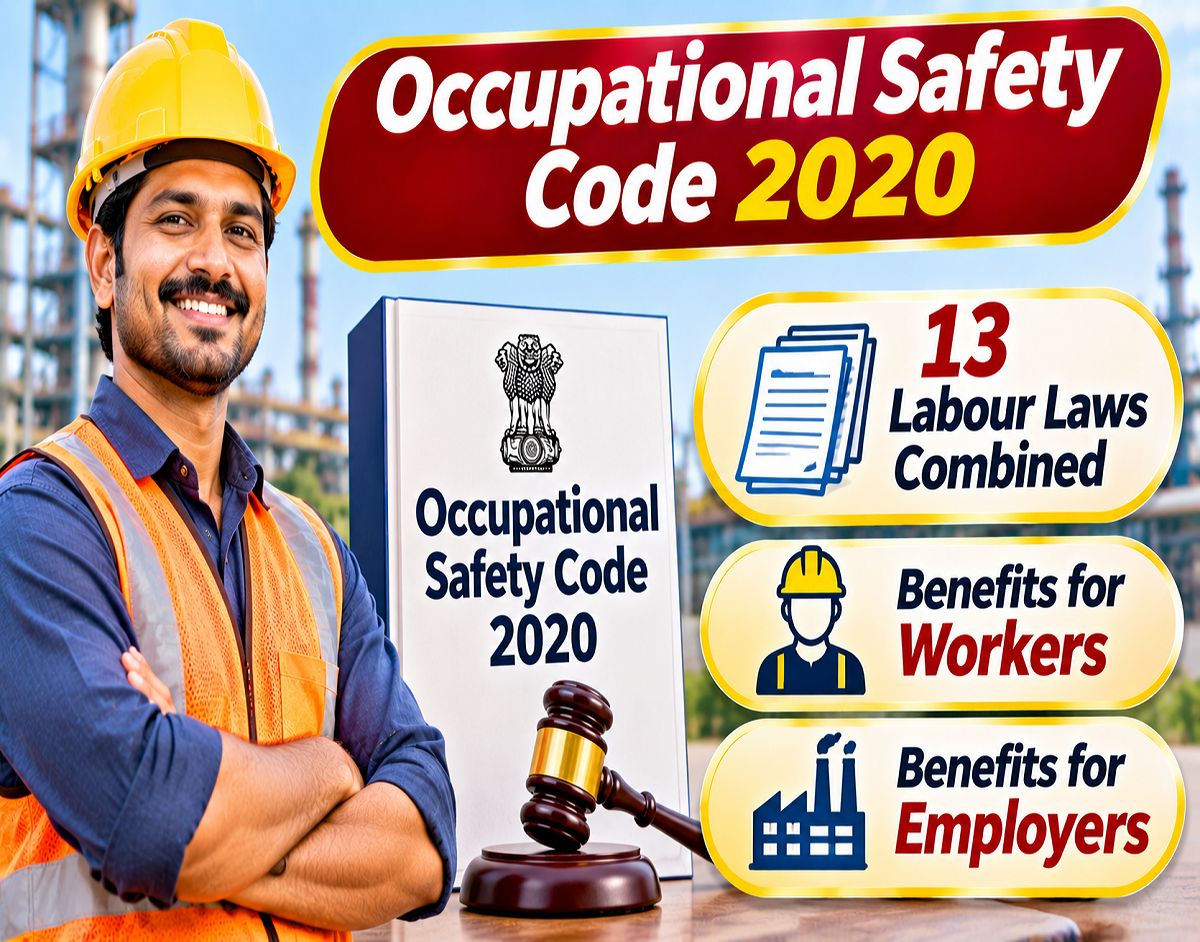
Occupational Safety, Health and Working Conditions Code 2020: India's labour law framework includes a major reform aimed at improving workplace safety, protecting employees' health and simplifying compliance requirements for businesses. The Occupational Safety, Health and Working Conditions Code, 2020, commonly known as the OSH Code, consolidates 13 central labour laws into a single legislative framework.
A public awareness message describes the reform as a step towards creating a safer, fairer and future-ready labour ecosystem.
The Code seeks to establish a more consistent regulatory framework for occupational safety, health and working conditions across covered establishments and industries.
Its provisions address matters such as workplace safety, employee welfare, working hours, health standards and employers' responsibilities.
However, the Code's practical application depends on its commencement provisions, applicable rules and the category of establishment or worker concerned.
What Is the Occupational Safety, Health and Working Conditions Code, 2020?
The Occupational Safety, Health and Working Conditions Code, 2020, is one of India's four major labour codes introduced to reorganise and modernise central labour legislation.
It brings together provisions previously contained in 13 separate central laws dealing with occupational safety, health and working conditions.
The objective is to reduce fragmentation in the legal framework while providing a common structure for regulating covered workplaces.
Earlier, different categories of establishments were governed by separate laws, often with distinct compliance procedures and administrative requirements.
The consolidated Code is intended to make the regulatory system more consistent while retaining provisions relevant to specific industries and employment categories.
Which 13 Labour Laws Are Consolidated Under the OSH Code?
The Code brings together legislation covering factories, mines, construction work, contract labour, migrant workers and several other sectors.
| S. No. | Central Labour Law |
|---|---|
| 1 | Factories Act, 1948 |
| 2 | Mines Act, 1952 |
| 3 | Dock Workers (Safety, Health and Welfare) Act, 1986 |
| 4 | Building and Other Construction Workers (Regulation of Employment and Conditions of Service) Act, 1996 |
| 5 | Plantations Labour Act, 1951 |
| 6 | Contract Labour (Regulation and Abolition) Act, 1970 |
| 7 | Inter-State Migrant Workmen (Regulation of Employment and Conditions of Service) Act, 1979 |
| 8 | Working Journalists and Other Newspaper Employees (Conditions of Service) and Miscellaneous Provisions Act, 1955 |
| 9 | Working Journalists (Fixation of Rates of Wages) Act, 1958 |
| 10 | Motor Transport Workers Act, 1961 |
| 11 | Sales Promotion Employees (Conditions of Service) Act, 1976 |
| 12 | Beedi and Cigar Workers (Conditions of Employment) Act, 1966 |
| 13 | Cine-Workers and Cinema Theatre Workers (Regulation of Employment) Act, 1981 |
The consolidation does not mean that identical rules apply to every workplace. Several provisions remain specific to particular industries or categories of employment.
When Did the Occupational Safety Code Come Into Effect?
Although the legislation was enacted in September 2020, it did not come into force immediately.
The central government officially brought the OSH Code into effect on November 21, 2025, alongside the other three labour codes. The commencement date is confirmed by the government notification and the Ministry of Labour and Employment.
The four labour codes collectively rationalise 29 central labour laws. The OSH Code alone consolidates 13 of those laws.
Key Benefits of the OSH Code for Employees
The legislation introduces a common framework for regulating safety, health and working conditions in covered establishments.
Important provisions include:
- Workplace safety: Requirements concerning occupational hazards, safety standards and employers' responsibilities.
- Health checkups: Provisions for free annual health examinations for prescribed categories of employees.
- Appointment letters: Formal documentation of employment to improve transparency.
- Working conditions: Rules addressing working hours, rest intervals, leave and welfare facilities.
- Women employees: Provisions permitting women to work across establishments, including night shifts, subject to consent and prescribed safety measures.
- Migrant workers: Measures relating to eligible inter-state migrant workers, including specified welfare benefits.
The Ministry of Labour and Employment has highlighted these protections in its official explanation of the labour codes.
How Does the New Code Simplify Compliance for Employers?
One of the principal objectives of the reform is to make regulatory compliance more streamlined.
Under the earlier framework, employers operating across multiple sectors could face different registration, licensing and reporting requirements.
The consolidated Code provides for measures such as common registration arrangements, electronic filings, licensing reforms and more standardised administrative procedures.
For eligible businesses, these changes are intended to reduce duplication and improve clarity.
However, simplification does not remove an employer's responsibility to provide safe working conditions or comply with applicable labour standards.
Does the OSH Code Apply to Every Employee?
The Code covers a range of establishments and industries, but its provisions do not necessarily apply identically to every worker.
Coverage can depend on the type of establishment, number of employees, nature of work and specific statutory provisions.
Certain safety and welfare requirements apply to establishments meeting prescribed employment thresholds, while hazardous occupations may attract additional obligations.
For example, the government has described provisions covering establishments with 10 or more workers, alongside protections relevant to hazardous or life-threatening occupations.
Workers and employers should therefore consult the relevant provisions rather than assuming that every benefit applies universally.
What About Working Hours and Overtime?
The OSH Code contains provisions concerning working hours and overtime.
The applicable framework addresses daily and weekly working limits, rest arrangements and additional payment for qualifying overtime work.
Overtime is subject to statutory conditions, including the prescribed rate of payment and employee consent where required.
Specific arrangements may differ according to the category of establishment and the applicable rules.
Employers should verify the relevant requirements before changing duty schedules.
What Does the Code Mean for Women Workers?
The legislation includes provisions intended to expand employment opportunities for women while maintaining workplace safety requirements.
Women may work in different types of establishments and during night hours, subject to their consent and applicable safeguards.
Such safeguards may include prescribed measures relating to safety, transportation and working conditions.
The objective is to allow wider participation in employment without removing employers' responsibilities for worker protection.
Are Free Annual Health Checkups Mandatory?
The Code provides for free annual health examinations for employees covered by the relevant provisions and prescribed conditions.
The government has identified annual health checkups as an important worker welfare measure under the new labour framework.
However, the exact coverage and implementation requirements must be understood through the applicable rules.
Employees should contact their employer or relevant labour authority to determine whether they are entitled to this facility.
OSH Code 2020: Important Details at a Glance
| Particulars | Details |
|---|---|
| Official name | Occupational Safety, Health and Working Conditions Code, 2020 |
| Year enacted | 2020 |
| Effective date | November 21, 2025 |
| Central labour laws consolidated | 13 |
| Responsible ministry | Ministry of Labour and Employment |
| Main areas | Workplace safety, health, welfare and working conditions |
| Employer compliance | Registration, licensing, reporting and safety obligations |
| Worker protections | Health, safety, employment documentation and other applicable benefits |
| Applicable rules | Central and state rules, depending on jurisdiction |
Why Is the OSH Code Important for India's Labour System?
The reform seeks to address the complexity created by multiple laws governing different categories of workplaces.
A consolidated legal framework can make it easier for workers to understand their rights and for employers to identify their obligations.
However, the practical success of the legislation depends on effective implementation, workplace inspections, employer compliance and accessible grievance mechanisms.
The government has also worked with states and Union Territories on the rules needed for implementation.
Workers should be aware of their rights, while employers should regularly review their compliance responsibilities.
Where Can Workers and Employers Find Official Information?
The Ministry of Labour and Employment publishes the labour codes, rules, notifications and frequently asked questions through its official website.
Readers can consult the Ministry of Labour and Employment's Labour Codes page for official documents.
For workplace-specific questions, employees and businesses should contact the appropriate labour department or obtain qualified legal guidance.
Final Takeaway
The Occupational Safety, Health and Working Conditions Code, 2020, consolidates 13 central labour laws into one framework designed to improve workplace safety, simplify compliance and establish more consistent employment standards.
The Code came into effect on November 21, 2025, as part of the government's broader labour law reforms.
Its provisions address important matters including occupational health, safety requirements, working conditions, employment documentation and welfare facilities.
For workers, understanding the applicable protections is important. For employers, compliance with the Code and relevant rules remains a legal responsibility.
Source Credit: Public awareness message on the Occupational Safety, Health and Working Conditions Code, 2020; Ministry of Labour and Employment, Government of India; Press Information Bureau backgrounder dated November 22, 2025; and official commencement notification dated November 21, 2025.