Business
NPS for Gig Workers: Start Retirement Savings With Small Contributions; Check Eligibility, PRAN and Pension Rules
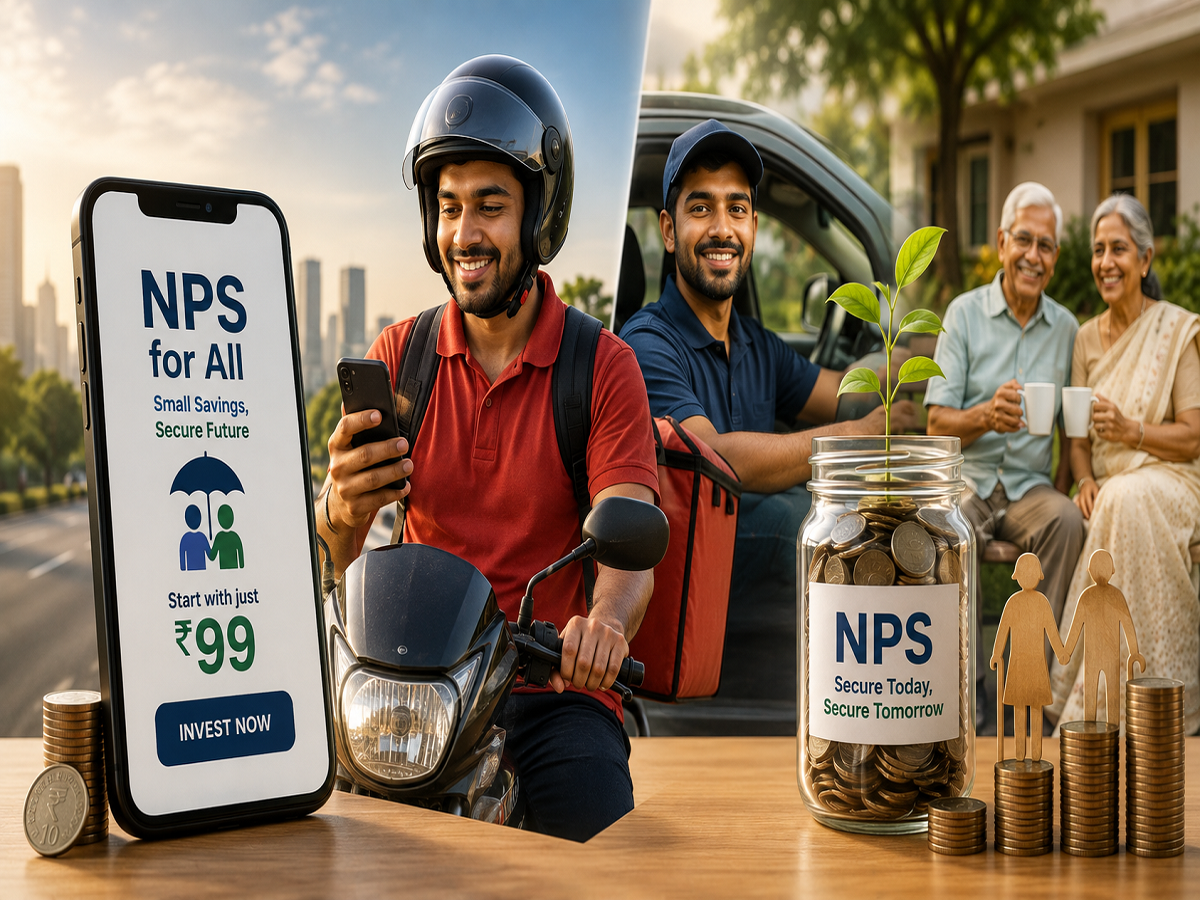
India's rapidly expanding gig economy has created earning opportunities for millions of delivery partners, drivers and service professionals. However, unlike many salaried employees, gig workers often do not have access to conventional employer-backed retirement benefits.
The NPS e-Shramik model, facilitated under the pension framework regulated by the Pension Fund Regulatory and Development Authority (PFRDA), aims to address this gap by making long-term retirement savings more accessible to platform and gig workers.
The model is designed around the irregular income patterns common in gig work. Instead of requiring workers to commit to a large fixed monthly contribution, it provides flexibility in how and when money is contributed.
Small amounts such as ₹99 can be contributed, allowing workers to begin building retirement savings without committing a significant portion of their earnings at once.
What Is the NPS e-Shramik Model?
The NPS e-Shramik model is intended to bring gig and platform workers within the National Pension System ecosystem.
Workers associated with food delivery, grocery delivery, ride-hailing, logistics and home-service platforms can potentially build a retirement corpus through NPS rather than depending entirely on personal savings.
The underlying idea is straightforward: even small contributions made regularly over a long period can accumulate into a larger retirement fund.
Because NPS is market-linked, however, the eventual corpus is not guaranteed and depends on contributions, investment performance and the time for which the money remains invested.
Can Workers Really Start With ₹99?
One of the notable features of the model is contribution flexibility.
Gig workers often experience variations in their earnings from one day or week to another. A rigid monthly savings commitment may therefore be difficult for some workers to maintain.
Under the flexible approach, a worker may make relatively small contributions according to available income. An amount such as ₹99 can be used as an example of a small contribution rather than requiring a large fixed monthly investment.
This allows workers to save more during periods of higher earnings and adjust contributions when income is lower, subject to applicable NPS rules.
Who Can Contribute to the NPS Account?
The framework can accommodate different contribution arrangements.
Depending on the model adopted by the platform or aggregator, contributions may come from the worker, the aggregator, or potentially both, subject to the applicable structure.
This feature can make retirement savings more adaptable for the gig economy, where traditional employer-employee arrangements may not always exist.
Workers should check the specific terms offered through their platform because contribution arrangements may differ between aggregators.
Which Gig Workers Could Benefit?
The model is particularly relevant to people earning through app-based and digital platforms.
This can include workers involved in areas such as:
- Food and restaurant delivery
- Grocery and quick-commerce delivery
- Ride-hailing and mobility services
- Logistics and parcel delivery
- Home repair and maintenance services
- Beauty and personal-care services
- Other eligible platform-based work
The important factor is not simply the name of the app a worker uses, but whether the worker is being onboarded under the applicable NPS e-Shramik framework.
How Does Registration Work?
The onboarding process is designed to be largely digital so that workers do not have to navigate complicated paperwork.
Basic personal and financial information is required to complete the Know Your Customer (KYC) process.
This can include details such as the applicant's name, address, PAN, mobile number and bank account information.
Identity verification may be completed through Aadhaar-based e-KYC or other permitted KYC mechanisms, depending on the process available at the time of registration.
Workers should ensure that all information submitted during onboarding matches their official documents to avoid problems with verification or future withdrawals.
What Is PRAN and Why Is It Important?
Once registration and verification are completed, the NPS subscriber receives a Permanent Retirement Account Number (PRAN).
PRAN is important because the NPS account belongs to the subscriber rather than being permanently tied to one employer or digital platform.
This portability can be particularly useful for gig workers, who frequently move between apps or may simultaneously earn through multiple platforms.
Changing Platforms Does Not Mean Losing the NPS Account
Consider a delivery worker who starts working through one food-delivery platform and later shifts to another delivery, mobility or service platform.
The worker does not need to abandon the accumulated retirement corpus simply because the platform has changed.
The NPS account remains associated with the subscriber's PRAN and can continue subject to the applicable portability and contribution framework.
This is a significant advantage for gig workers because their careers may involve frequent movement between platforms and different types of work.
Nomination Is Important for Retirement Savings
Nomination is another important part of maintaining an NPS account.
Under the onboarding process described for the model, subscribers can provide relevant family and nominee information within the prescribed timeline.
Workers should complete nomination details accurately rather than postponing them indefinitely.
Having an updated nominee can simplify the process for family members in the event of the subscriber's death, subject to NPS claim rules.
Where Is the NPS Money Invested?
NPS is not a conventional bank deposit.
The money accumulated in an NPS account is invested through pension funds across permitted asset categories. These can include equities, corporate debt and government securities, depending on the subscriber's investment choice and applicable NPS framework.
This means returns are linked to the performance of the underlying investments.
Equity exposure can provide the potential for long-term capital appreciation, while debt and government securities can add diversification.
However, because NPS is market-linked, returns cannot be guaranteed in advance.
What Happens to the Corpus at Retirement?
NPS is specifically designed as a retirement product, so exit rules apply to the accumulated corpus.
At normal exit, subscribers may be allowed to withdraw an eligible portion of the corpus as a lump sum, while the portion required under prevailing NPS rules is used to purchase an annuity.
An annuity can then provide periodic pension income after retirement.
It is important to understand that the pension amount itself is not automatically guaranteed at a fixed level simply because someone has opened an NPS account.
The eventual retirement corpus depends on how much has been contributed and the investment returns earned. The pension income then depends on factors including the amount used to purchase the annuity, the annuity option chosen and the rates available at that time.
Why Small Contributions Can Still Matter
The most significant benefit of starting early is time.
A worker contributing a small amount at a young age may have several decades for the retirement savings to accumulate. Increasing contributions as income grows can further strengthen the final corpus.
However, ₹99 alone should not be viewed as an amount that guarantees a large retirement pension.
The eventual outcome depends heavily on the frequency and size of contributions, investment returns and investment duration.
Workers should therefore increase their contributions whenever their financial position allows instead of focusing only on the minimum amount required to get started.
Is NPS e-Shramik Useful for Gig Workers?
For gig workers without access to a conventional employer pension, NPS can provide a structured mechanism for building retirement savings.
Its portability is especially relevant because workers can change platforms without necessarily having to start their retirement planning from scratch.
Flexible contributions can also make the system better suited to people whose income changes from week to week.
At the same time, workers should remember that NPS is a long-term, market-linked retirement product, not a guaranteed-return savings scheme. It also comes with withdrawal and exit conditions.
The ₹99 contribution example demonstrates that starting retirement savings does not necessarily require a large initial amount. But building a meaningful retirement corpus ultimately requires consistent contributions over time.
For delivery partners, drivers and other platform workers, beginning early and gradually increasing contributions as earnings improve could provide a more structured route towards financial security after their working years.
Disclaimer: This article is for general informational purposes only and does not constitute investment advice. NPS investments are market-linked, and returns are not guaranteed. Contribution requirements, withdrawal rules, tax provisions and other conditions may change. Workers should verify the latest guidelines from PFRDA/NPS authorities and their participating platform before enrolling or making financial decisions.