
LIFESTYLE
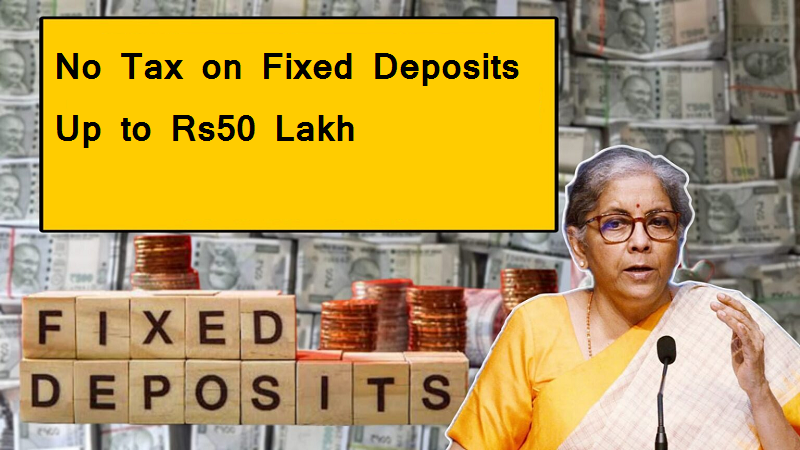
Income Tax on FD: No Tax on Fixed Deposits Up to ₹50 Lakh – A Big Relief for Common Citizens
Income Tax on FD: A Popular Investment Option in India
When it comes to investing money in India, most people prefer fixed deposits (FDs) as a safe and reliable option. Investing in a bank FD offers a good return, but at the same time, the interest earned on FDs is subject to taxation. However, the government has now introduced a major relief—income from FDs up to ₹50 lakh will not be taxed. Let’s understand this development in detail.
No Tax on Fixed Deposits Up to ₹50 Lakh
Many individuals invest their money in fixed deposits with the expectation of earning stable returns. However, they often worry about paying taxes on the interest earned. Now, there is good news for such investors.
If an individual has a fixed deposit of up to ₹50 lakh, they will not have to pay any tax on the interest income. Moreover, there will be no requirement to file an Income Tax Return (ITR) if their total earnings come only from FD interest and do not exceed ₹4 lakh annually. Let’s break this down further.
How to Avail Tax Exemption on FD Interest?
Under the government's new tax regime, income up to ₹4 lakh from interest on FDs is completely tax-free. This means if your total earnings come solely from bank interest and are below ₹4 lakh, you are exempt from paying any tax.
Example for Better Understanding
Suppose you invest ₹50 lakh in a fixed deposit scheme that offers an annual interest rate of 7.75%. In this case, you would earn ₹3,87,500 as interest in a year. Since this amount is below ₹4 lakh, you will not be liable to pay any tax on this income.
How to Avoid TDS Deductions?
A common concern for FD investors is the deduction of Tax Deducted at Source (TDS) by banks. Whenever a bank credits interest, it may deduct TDS as per government regulations. However, if your total income comes only from FD interest and remains below ₹4 lakh, you can submit a declaration form to the bank to prevent TDS deductions.
Steps to Avoid TDS on FD Interest
- If you are a senior citizen (above 60 years), submit Form 15H to the bank.
- If you are below 60 years, submit Form 15G to the bank.
- These forms should be submitted at the beginning of each financial year (before April 1) to ensure the bank does not deduct TDS on your interest income.
Revised TDS Rules for FD Interest
The government has increased the TDS exemption limit, benefiting both senior citizens and regular investors.
- For individuals below 60 years, TDS will be deducted only if the annual interest income exceeds ₹50,000.
- For senior citizens (above 60 years), TDS will be applicable only if the interest income exceeds ₹1,00,000 annually.
This new regulation provides significant relief to fixed deposit investors, ensuring that more people can enjoy tax-free earnings on their FD returns.