Business
8th Pay Commission: From Basic Pay to HRA and TA, Key Salary Issues to Be Discussed on August 7 & 10
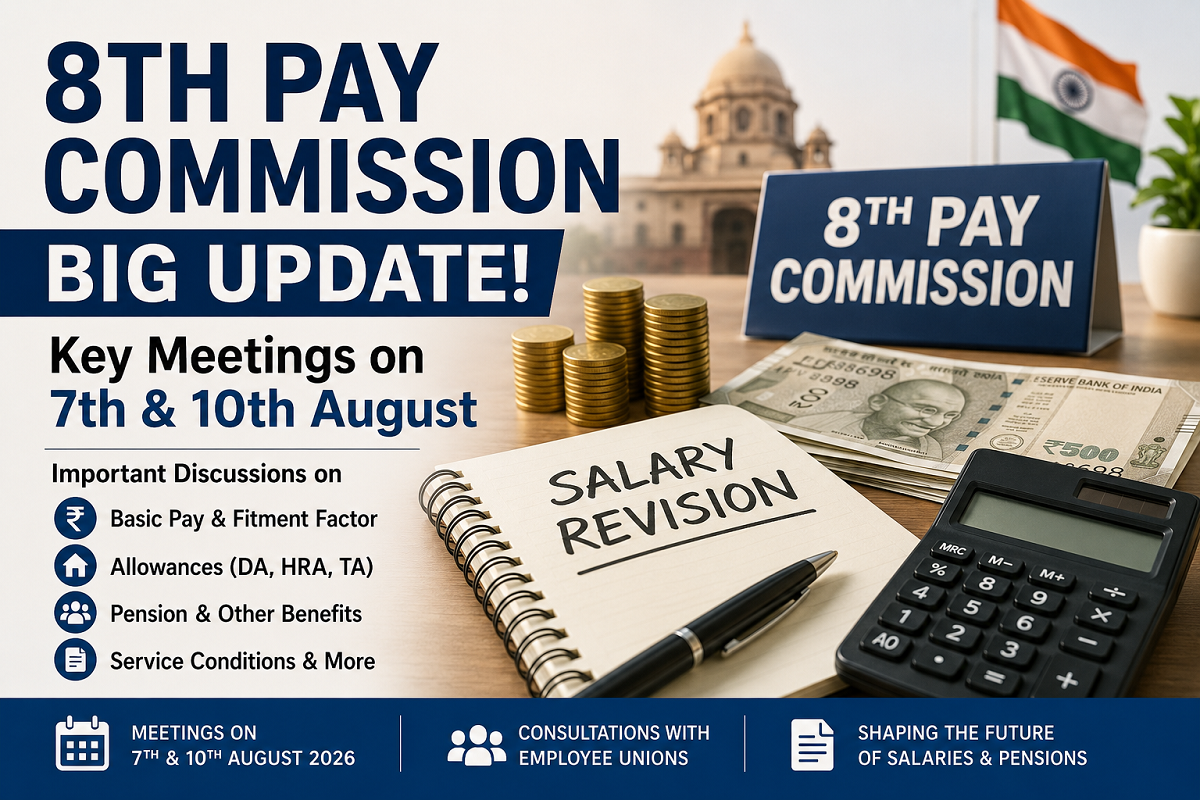
8th Pay Commission Update: The 8th Central Pay Commission has entered a crucial phase of stakeholder consultations. Meetings with employee unions and federations are scheduled for August 7 and August 10, 2026, where discussions will focus on key issues including basic pay, fitment factor, allowances, and pension-related benefits that could shape the next salary revision for Central Government employees.
8th Pay Commission Moves Into a Critical Consultation Phase
The 8th Central Pay Commission has accelerated its consultation process as it prepares recommendations for the next revision of salaries and pensions for nearly one crore Central Government employees and pensioners.
As part of this exercise, the Commission has invited employee unions, federations, and associations representing Central Government and Union Territory (UT) employees in Delhi to participate in stakeholder meetings on August 7 and August 10, 2026.
According to a notice issued on July 23, 2026, these discussions are intended to gather feedback and recommendations from employee representatives before the Commission finalizes its report.
Why the August Meetings Are Important
The upcoming meetings are expected to play a significant role in shaping the Commission's recommendations.
Employee organisations will have an opportunity to present their views on salary revision, allowances, pension benefits, and service conditions. These discussions will help the Commission evaluate the demands of various employee groups before submitting its final report to the Central Government.
The recommendations made by the Commission will eventually determine the next pay structure for lakhs of serving employees and retired pensioners.
Three Key Areas Expected to Dominate the Discussions
The revised salary structure under the 8th Pay Commission is likely to revolve around three major components.
1. Basic Pay and Fitment Factor
Basic pay forms the foundation of a government employee's salary. It also determines several other financial benefits, including:
- Provident Fund (PF)
- Gratuity
- Pension
- Various allowances
To calculate the revised salary, the Commission applies a fitment factor, which is a multiplier used to convert the existing basic pay into the new pay structure.
The National Council–Joint Consultative Machinery (NC-JCM) has reportedly proposed a fitment factor of 3.83.
Meanwhile, the All India NPS Employees Federation (AINPSEF) has suggested increasing the family consumption unit from 3 to 4.4, arguing that it would better reflect current household expenses and support a higher basic pay calculation.
2. Allowances: HRA, DA and Travel Allowance
Apart from basic pay, employee organisations are expected to seek revisions in several major allowances.
House Rent Allowance (HRA)
AINPSEF has reportedly recommended the following HRA rates:
- 36% for employees posted in X-category cities
- 24% for Y-category cities
- 12% for Z-category cities
The federation has also suggested introducing an automatic mechanism under which HRA would increase whenever Dearness Allowance (DA) is revised.
Travel Allowance (TA)
For employees in Level-1, the proposal seeks to increase the minimum Travel Allowance (TA) to ₹9,000 per month.
If accepted, these revisions could significantly improve the overall monthly earnings of Central Government employees.
3. Gross Salary
Gross salary is calculated by combining:
- Basic Pay
- Dearness Allowance (DA)
- House Rent Allowance (HRA)
- Travel Allowance (TA)
- Other admissible allowances
According to estimates based on the proposals submitted by employee organisations, a Level-1 employee's monthly salary could rise from approximately ₹37,080 to around ₹61,344, representing an increase of nearly 65%.
However, these figures are based on proposals submitted during the consultation process and do not represent final recommendations or approved salary revisions.
When Could the New Pay Commission Recommendations Be Implemented?
The 8th Central Pay Commission was constituted on November 3, 2025, with a tenure of 18 months.
Based on this timeline, the Commission is expected to submit its final report sometime between February 2027 and the middle of 2027.
Historically, the implementation of Central Pay Commission recommendations has taken two to three years after the submission of the final report, as the government reviews the proposals before granting approval.
Will Employees Receive Arrears?
Employee organisations have expressed the expectation that the revised pay structure could be made effective from January 1, 2026, with arrears if the government approves such a decision.
However, no official announcement has been made regarding the effective date or payment of arrears. Any decision on implementation and retrospective benefits will be taken by the Central Government only after it considers the Commission's final recommendations.
What Employees Should Watch Next
The stakeholder meetings scheduled for August 7 and August 10 are expected to provide valuable input for the 8th Pay Commission's deliberations. While employee unions are likely to press for a higher fitment factor, revised allowances, and improved pension benefits, the Commission will review all representations before preparing its final recommendations.
For now, Central Government employees and pensioners should treat the proposals under discussion as part of the consultation process, as the final salary structure will only become clear after the Commission submits its report and the government announces its decision.