Business
DA Hike 2026: Salary May Rise by ₹540 to ₹4,000 Monthly if DA Increases by 3% or 4%; Check Full Calculation
7th Pay Commission DA Update 2026: Central government employees and pensioners are awaiting an official announcement regarding the Dearness Allowance (DA) revision for July 2026. With the existing DA rate reported at 60%, attention has turned to whether the government will approve an additional increase of three or four percentage points.
If the government announces a three-percentage-point revision, DA would increase from 60% to 63%. A four-percentage-point revision would take it to 64%.
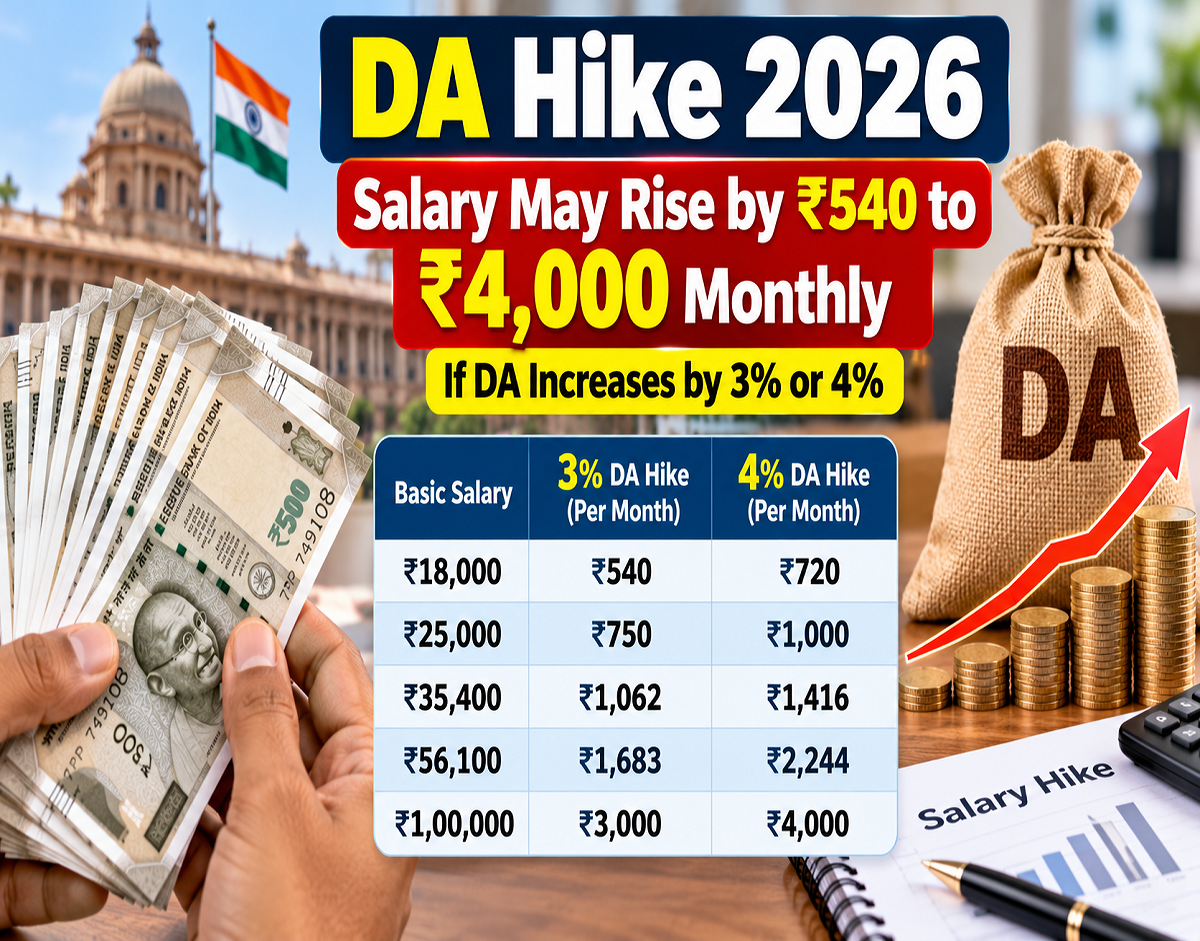
For an employee drawing ₹18,000 in basic salary, these two scenarios would translate into an additional ₹540 or ₹720 per month, respectively. Employees with higher basic salaries would receive proportionately larger increases.
However, neither the 63% nor the 64% DA rate should be considered officially approved until the central government issues a formal announcement.
Meanwhile, Himachal Pradesh has separately announced a five-percentage-point DA increase for eligible state government employees ahead of Diwali.
DA Hike July 2026: Important Details
| Particulars | Details |
|---|---|
| Beneficiaries | Eligible central government employees and pensioners |
| Current reported DA rate | 60% |
| Possible increase | 3 or 4 percentage points |
| DA after a 3-point increase | 63% |
| DA after a 4-point increase | 64% |
| Revision cycle | July 2026 |
| Official approval | Awaited |
| Calculation basis | Basic pay |
| Inflation reference | All-India CPI-IW |
The figures below illustrate possible outcomes rather than confirmed salary revisions.
DA Hike Calculator: How Much Will Your Salary Increase?
Calculate your additional monthly DA
Enter your basic salary and choose a hypothetical DA revision.
Monthly basic pay (₹)
Possible DA increase
3 percentage points
4 percentage points
Additional monthly DA
₹1,062
Current DA at 60%
₹21,240
Revised DA at 63%
₹22,302
Additional DA over 12 months
₹12,744
Basic pay + revised DA
₹57,702
Illustrative gross DA calculations only. Other allowances, taxes, deductions and actual implementation dates are excluded.
DA Hike Salary Table: 3% vs 4% Increase
The following comparison shows how different basic salary levels would be affected.
| Basic Monthly Salary | Current DA at 60% | Extra DA if 63% | Extra DA if 64% |
|---|---|---|---|
| ₹18,000 | ₹10,800 | ₹540 | ₹720 |
| ₹25,000 | ₹15,000 | ₹750 | ₹1,000 |
| ₹30,000 | ₹18,000 | ₹900 | ₹1,200 |
| ₹35,400 | ₹21,240 | ₹1,062 | ₹1,416 |
| ₹44,900 | ₹26,940 | ₹1,347 | ₹1,796 |
| ₹56,100 | ₹33,660 | ₹1,683 | ₹2,244 |
| ₹67,700 | ₹40,620 | ₹2,031 | ₹2,708 |
| ₹1,00,000 | ₹60,000 | ₹3,000 | ₹4,000 |
These calculations assume that the employee is eligible for the stated DA rates and that the entire revision applies to the same basic pay.
How Is Dearness Allowance Calculated?
Dearness Allowance is a salary component intended to help eligible government employees manage the impact of inflation.
For central government employees covered by the applicable Seventh Central Pay Commission framework, DA is calculated as a percentage of basic pay.
The formula is:
\[ \text{DA Amount}=\frac{\text{Basic Pay}\times\text{DA Rate}}{100} \]
For example, an employee with a basic salary of ₹35,400 currently receiving DA at 60% would get:
\[ ₹35,400\times60\%=₹21,240 \]
If DA rises to 63%, the amount becomes:
\[ ₹35,400\times63\%=₹22,302 \]
The monthly increase would therefore be:
\[ ₹22,302-₹21,240=₹1,062 \]
If DA instead rises to 64%, the allowance would become ₹22,656, representing an additional ₹1,416 per month.
Does a 3% DA Hike Mean Your Entire Salary Increases by 3%?
No. This is one of the most common misunderstandings surrounding DA revisions.
A three-percentage-point DA increase means employees receive an additional amount equal to 3% of their basic salary.
It does not mean that their entire gross salary or take-home salary automatically increases by 3%.
For example, consider an employee whose monthly basic salary is ₹40,000.
A three-percentage-point DA revision would increase the allowance by ₹1,200 per month.
However, the employee's final take-home salary would depend on other allowances, tax deductions, retirement contributions and applicable payroll rules.
The actual increase in the bank-credit amount may therefore differ from the additional DA shown in the salary calculation.
What Is the Role of CPI-IW in DA Revision?
Central government DA revisions are linked to movements in the All-India Consumer Price Index for Industrial Workers (CPI-IW).
This index tracks changes in the prices of goods and services relevant to industrial-worker households.
The DA calculation considers the applicable 12-month average of the index under the Seventh Pay Commission framework.
The resulting rate is subject to the government's prescribed calculation and rounding rules.
Although DA revisions generally follow January and July cycles, the announcement and payment dates may occur later.
Consequently, employees should distinguish between the effective date of a revision and the date when the government formally announces it.
Will Pensioners Also Receive the Benefit?
Central government pensioners generally receive Dearness Relief (DR), rather than Dearness Allowance.
DR is calculated as a percentage of eligible basic pension.
If the government approves a corresponding three-percentage-point DR increase, a pensioner receiving ₹20,000 in basic pension would receive an additional ₹600 per month.
A four-percentage-point increase would mean ₹800 more per month.
The actual benefit would depend on the government's official DR order and the pensioner's eligibility.
Will Employees Receive DA Arrears From July 2026?
If a revised DA rate is approved with effect from July 1, 2026, employees may become eligible for arrears covering the period between the effective date and the implementation date.
For example, an employee with ₹30,000 basic pay would receive an additional ₹900 per month under a three-percentage-point revision.
If four months of arrears were payable, the illustrative amount would be ₹3,600.
Under a four-percentage-point revision, the same employee would receive an additional ₹1,200 monthly, equivalent to ₹4,800 for four months.
These amounts are examples only. The number of payable months, applicable salary figures and disbursement schedule would depend on the official government order.
Himachal Pradesh Announces Separate 5% DA Increase
While central government employees await their next DA decision, Himachal Pradesh has announced a separate revision for eligible state employees.
On October 23, 2026, Chief Minister Sukhvinder Singh Sukhu announced a combined five-percentage-point increase in Dearness Allowance.
According to the announcement, the revised DA rate will increase from 45% to 50%.
The five-percentage-point change comprises a fresh four-percentage-point revision and one previously pending percentage point.
The state government has also announced ₹10,000 toward outstanding pay-revision arrears for eligible Class IV employees.
The arrears payment is reportedly scheduled for November 1, 2026.
This state-level decision is separate from the pending central government DA revision.
When Will the Central Government Announce the Next DA Hike?
As of October 23, 2026, the central government's July-cycle DA revision remained subject to an official announcement.
Reports have discussed possible increases of three or four percentage points, but these should be treated as scenarios until the Union Cabinet approves a specific rate.
Employees and pensioners should monitor official government communications for confirmation of the revised percentage, effective date and arrears arrangements.
Final Takeaway
A possible three- or four-percentage-point DA increase could provide additional monthly income to eligible central government employees and pensioners.
For employees earning ₹18,000 in basic pay, the monthly increase would be ₹540 or ₹720. At ₹56,100 basic pay, the additional allowance would be ₹1,683 or ₹2,244.
The key point is that DA increases are calculated on basic pay, not on the employee's entire gross salary.
Until the central government formally announces the next revision, the 63% and 64% figures remain hypothetical.
Disclaimer: Salary and pension calculations are illustrative. The final DA/DR rate, implementation date and arrears will depend on official government orders.